

S5P-TROPOSIF
ESA TROPOSIF – Solar Induced Chlorophyll Fluorescence from TROPOMI
NOVELTIS led or supported these projects, which used to have their own websites. Their presentation is now gathered here.





Sentinel-5p Innovation – Solar Induced Chlorophyll Fluorescence
Project description
The ESA TROPOSIF project is one of the seven themes of the Sentinel-5p+ Innovation (S5p+I) activity funded by ESA, which aims at developing novel scientific products and retrieval methods from the data acquired by the TROPOMI (TROPOspheric Monitoring Instrument) instrument aboard the Copernicus Sentinel-5 Precursor mission, launched in October 2017.
Although the Sentinel-5P mission was designed to monitor the Earth's atmosphere, TROPOMI's spectral and radiometric performance also enables the monitoring of terrestrial Solar Induced Fluorescence (SIF) with an unprecedented spatial and temporal resolution.
What is SIF?
Solar induced chlorophyll fluorescence (SIF) is an electromagnetic signal emitted by the chlorophyll a of assimilating plants: part of the energy absorbed by chlorophyll a is not used for photosynthesis, but emitted at longer wavelengths as a two-peak spectrum roughly covering the 650–850 nm spectral range. The SIF signal responds instantaneously to perturbations in environmental conditions such as light and water stress, which makes it a direct proxy for photosynthetic activity. However, SIF emission constitutes only a small fraction (typically 0.5%–2%) of the radiance at the top of the canopy, which is mostly composed of reflected sunlight, and its estimation from space-borne spectrometers requires both high spectral resolution and advanced retrieval schemes.
Why should we care about SIF?
Over the last few years, SIF observations from space have emerged as a promising resource for evaluating the spatio-temporal distribution of gross carbon uptake (GPP, gross primary productivity) by terrestrial ecosystems, which still remains uncertain to date. For climate studies, our ability to anticipate the evolution of net and gross carbon fluxes over the globe under a changing climate largely relies on global terrestrial biosphere models (TBMs). Their parameterization remains largely uncertain, and satellite SIF products are expected to provide a significant constraint (reduction in uncertainty) on the projections of the terrestrial carbon uptake.
Project objectives
The overarching goal of the ESA TROPOSIF project is twofold:
- First, derive a global SIF product from TROPOMI, which implies new developments in SIF retrieval and the comparison to existing state-of-the-art global SIF data sets from TROPOMI and OCO-2.
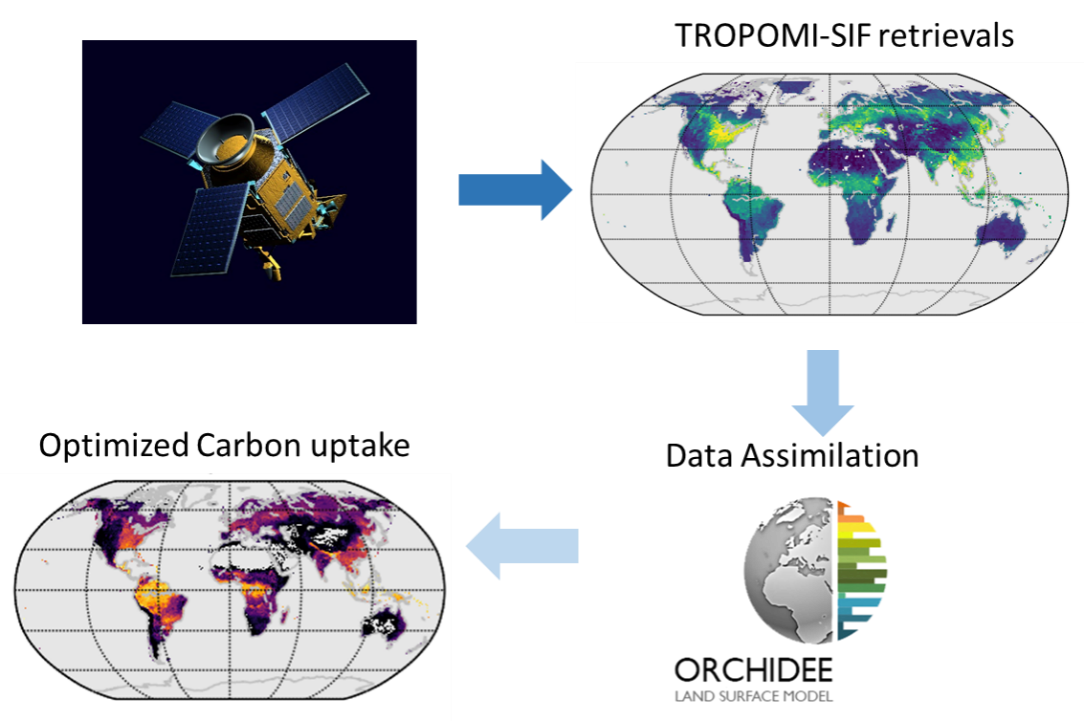
- Second, exploit the resulting SIF data set to demonstrate the positive impact that the TROPOMI SIF product can have on a range of vegetation and carbon cycle-related research topics. Among others, this is done through the assimilation of the SIF data set into the state-of-the-art ORCHIDEE terrestrial biosphere model. The project also investigates the potential of the TROPOMI SIF retrieval for the upcoming Sentinel-4 and Sentinel-5 missions, and promotes the SIF product among the climate and land surface modelling community.
Project partners
- NOVELTIS, France
- Universitat Politècnica de València, Spain
- LSCE – Laboratoire des Sciences du Climat et de l'Environnement, France
- SRON – Netherlands Institute for Space Research, Netherlands
Data access
The TROPOSIF products consist of:
- SIF estimates at 740 nm derived from a data-driven approach based on a linear forward model fitting TOA radiances in the far-red spectral region:
- SIF data set from the 743–758 nm window (baseline SIF product);
- SIF data set from the extended 735–758 nm window (secondary SIF product), with an enhanced signal-to-noise ratio but a higher sensitivity to atmospheric conditions;
- Spectral surface reflectance in 7 bands covering the 665–785 nm range.
The covered time period is May 2018 to March 2021.
TROPOSIF: daily SIF at 740 nm (from 743–758 nm)
TROPOSIF: daily NDVI
Data format
The TROPOSIF products are provided as ungridded data in self-explanatory netCDF-4 files. Two types of data files exist:
- L2 data: orbit files, all retrievals (with quality flag);
- L2B data: daily files, valid retrievals only.
Data availability
The L2B data are available at ftp.sron.nl/open-access-data-2/TROPOMI/tropomi/sif/v2.1/l2b/, under the TROPOSIF Data Use Policy.
Documents
- Product User Manual (PDF)
- TROPOSIF study and results (PDF)
Related publications
- Guanter, L., Aben, I., Tol, P., Krijger, J. M., Hollstein, A., Köhler, P., et al. (2015). Potential of the TROPOspheric Monitoring Instrument (TROPOMI) onboard the Sentinel-5 Precursor for the monitoring of terrestrial chlorophyll fluorescence. Atmospheric Measurement Techniques, 8(3), 1337–1352. doi:10.5194/amt-8-1337-2015
- Köhler, P., Frankenberg, C., Magney, T. S., Guanter, L., Joiner, J., & Landgraf, J. (2018). Global retrievals of solar induced chlorophyll fluorescence with TROPOMI: first results and inter-sensor comparison to OCO-2. Geophysical Research Letters. doi:10.1029/2018GL079031
- Bacour, C., Maignan, F., Peylin, P., MacBean, N., Bastrikov, V., Joiner, J., … & Frankenberg, C. (2019). Differences between OCO-2 and GOME-2 SIF products from a model-data fusion perspective. Journal of Geophysical Research: Biogeosciences. doi:10.1029/2018JG004938
- Bacour, C., Maignan, F., MacBean, N., Porcar-Castell, A., Flexas, J., Frankenberg, C., … & Bastrikov, V. (2019). Improving estimates of Gross Primary Productivity by assimilating solar-induced fluorescence satellite retrievals in a terrestrial biosphere model using a process-based SIF model. Journal of Geophysical Research: Biogeosciences. doi:10.1029/2019JG005040